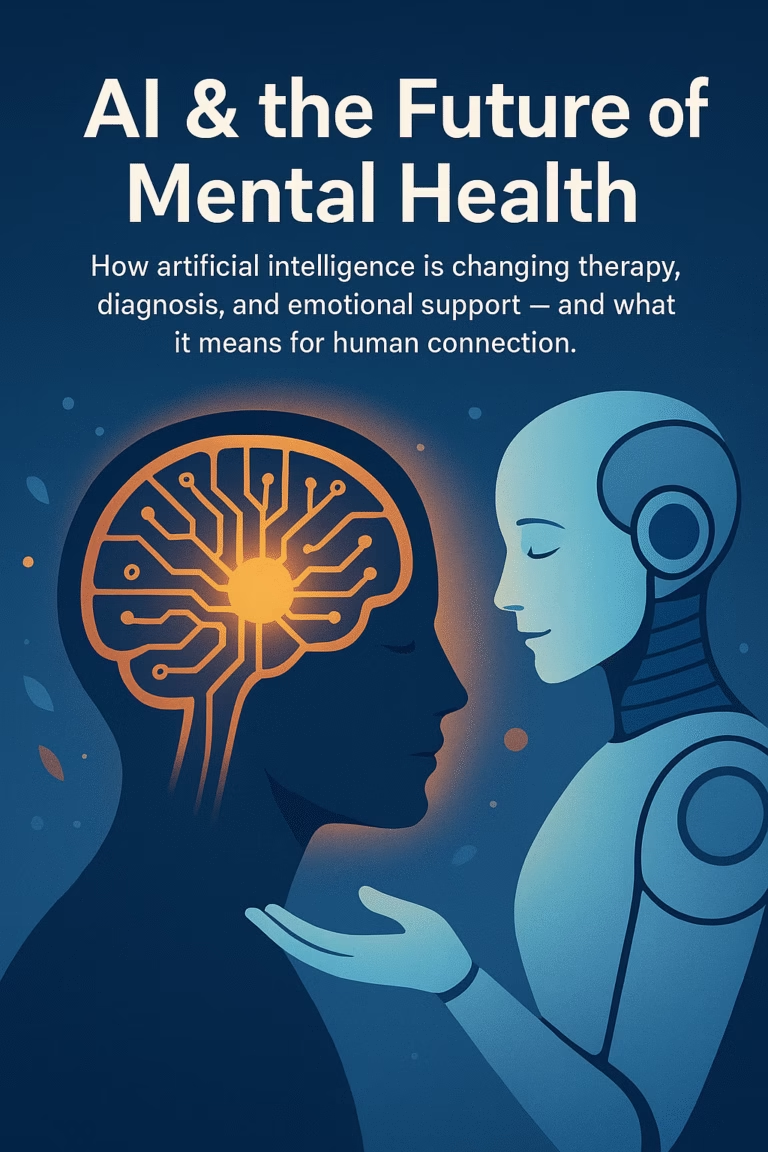

How artificial intelligence is changing therapy, diagnosis, and emotional support — and what it means for human connection
Introduction
Imagine having a therapist available 24/7, one who never gets tired, never judges, and costs a fraction of traditional therapy. For millions of people worldwide, this isn’t science fiction—it’s becoming reality through artificial intelligence. With nearly 700 million weekly users on ChatGPT alone, and countless others turning to specialized AI mental health platforms, we’re witnessing a fundamental shift in how people seek emotional support and psychological care.
But this revolution raises profound questions: Can algorithms truly understand the human psyche? What happens to the therapeutic relationship when silicon replaces empathy? And perhaps most importantly—are we solving a mental health crisis, or creating new problems we don’t yet understand?
The Current State of AI in Mental Health
The statistics tell a striking story of both promise and caution. The global AI in mental health market, valued at $1.80 billion in 2025, is projected to explode to $11.84 billion by 2034—a staggering 24.15% annual growth rate. This isn’t just investment capital chasing trends; it reflects a genuine crisis in mental healthcare accessibility.
According to recent research, nearly 50% of individuals who could benefit from therapeutic services cannot access them due to cost, availability, or stigma. AI is stepping into this gap, but acceptance remains divided. While 32% of individuals express openness to AI-based therapy, the majority—68%—still prefer human therapists, highlighting a fundamental tension in how we view mental healthcare.
Who’s Using AI for Mental Health?
A revealing survey of mental health professionals and community members found that 43% of mental health professionals and 28% of community members reported using AI tools in the past six months. Among both groups, ChatGPT emerged as the dominant platform, used by over half of AI adopters.
How AI is Transforming Mental Healthcare
1. Diagnosis and Early Detection
AI’s analytical capabilities are revolutionizing diagnostic accuracy. Recent studies report diagnostic accuracy rates averaging around 80%, with some specialized applications achieving rates above 90%. Machine learning algorithms can analyze patterns in EEG data, speech patterns, social media behavior, and even typing cadence to identify early warning signs of mental health conditions.
One particularly promising application involves analyzing brain activity data. Researchers using EEG feature transformation and machine learning methods achieved 89.02% accurate classification of certain mental health conditions—a level of precision that could enable earlier intervention and more personalized treatment plans.
The diagnostic power of AI includes:
- Pattern recognition in brain imaging and neurological data
- Speech and language analysis to detect depression, anxiety, and suicidal ideation
- Social media monitoring for behavioral changes indicative of mental health decline
- Continuous monitoring through wearable devices that track sleep, activity, and physiological markers
2. AI-Powered Therapy and Interventions
The therapeutic landscape is expanding beyond traditional office visits. AI chatbots and virtual therapists now provide cognitive behavioral therapy (CBT), dialectical behavior therapy (DBT), and other evidence-based interventions through smartphone apps and web platforms.
Recent innovations include platforms like Slingshot AI’s “Ash,” a therapy chatbot trained on real therapeutic conversations, representing a new generation of AI that attempts to replicate the nuances of human therapy. Unlike generic large language models, specialized therapeutic AI is designed with mental health frameworks embedded in their training.
Comparative effectiveness data, however, reveals an important caveat. Studies comparing AI-based therapy to human therapists show that while AI can provide meaningful support, human therapists still demonstrate superior outcomes in anxiety reduction. A comparative study using the Hamilton Anxiety Scale showed statistically significant differences (t-value of 2.85, p-value of 0.007), with the human therapist group experiencing higher anxiety reduction.
3. 24/7 Accessibility and Crisis Support
Perhaps AI’s most immediate benefit is availability. Unlike human therapists constrained by office hours and appointment schedules, AI platforms provide instant support at any time. For someone experiencing a panic attack at 3 AM or dealing with intrusive thoughts during a lonely evening, having immediate access to coping strategies and supportive conversation can be lifesaving.
The Critical Challenges and Risks
Data Quality and Bias
The effectiveness of AI is only as good as the data it learns from. Mental health conditions involve complex interactions of biological, psychological, and social factors that vary dramatically across cultures, demographics, and individual experiences. If training data is biased, incomplete, or unrepresentative, AI systems can perpetuate harmful stereotypes or provide inadequate care to underrepresented populations.
Research consistently highlights that incomplete or biased datasets lead to diagnostic errors, particularly in diverse populations. The risk is especially pronounced in mental health, where inappropriate treatments can severely impact vulnerable individuals.
The Loss of Human Connection
Mental health treatment has always been fundamentally relational. The therapeutic alliance—the trusting relationship between therapist and client—is consistently identified as one of the most powerful predictors of treatment success. Can an algorithm, no matter how sophisticated, replicate the warmth, genuine concern, and human understanding that characterize effective therapy?
Critics worry that AI mental health tools may provide a simulacrum of connection while actually increasing isolation. There’s a profound difference between feeling heard by another human being and receiving algorithmically generated responses, even if those responses are helpful.
Privacy and Ethical Concerns
When you share your deepest fears, traumas, and struggles with an AI system, where does that data go? Who has access to it? How might it be used? These aren’t hypothetical concerns—they’re critical questions that the field is still grappling with.
Mental health data is among the most sensitive information a person can share. The integration of AI raises complex issues around:
- Data storage and security
- Informed consent when algorithms evolve
- The potential for data breaches exposing vulnerable individuals
- The use of mental health data for purposes beyond direct care
- Questions about who owns the data and therapeutic insights generated
Regulation and Accountability
The mental health AI industry currently operates in a relatively unregulated space. When an AI provides harmful advice or fails to recognize a crisis situation, who bears responsibility? Traditional healthcare has established systems of accountability, licensing, and malpractice protections. AI mental health tools exist in a gray area where these protections may not apply.
Experts are calling for standardized labeling systems that would help users understand what AI mental health tools can and cannot do, similar to nutrition labels on food products. Such transparency could help people make informed decisions about when AI support is appropriate and when human intervention is necessary.
Key Statistics and Market Overview
| Metric | Value | Source |
|---|---|---|
| Global AI Mental Health Market (2025) | $1.80 billion | Globe Newswire Market Report |
| Projected Market Size (2034) | $11.84 billion | Globe Newswire Market Report |
| ChatGPT Weekly Users | Nearly 700 million | NPR Health Report |
| People Unable to Access Traditional Therapy | Nearly 50% | Stanford Report |
| Individuals Open to AI Therapy | 32% | ArtSmart AI Statistics |
| Average AI Diagnostic Accuracy | ~80% (90%+ in specialized applications) | PMC Study on AI Challenges |
| Mental Health Professionals Using AI | 43% (in past 6 months) | JMIR Mental Health Survey |
The Hybrid Future: AI + Human Care
The most promising path forward isn’t choosing between AI and human therapists—it’s finding the optimal integration of both. This hybrid model could leverage AI’s strengths while preserving the irreplaceable elements of human connection.
Potential Hybrid Models:
1. AI as the First Line of Support
AI chatbots could provide immediate coping strategies, psychoeducation, and crisis de-escalation, triaging individuals to human therapists when necessary.
2. AI-Enhanced Human Therapy
Therapists could use AI tools to analyze session notes, track patient progress, identify patterns across sessions, and receive evidence-based treatment suggestions—freeing them to focus on the relational aspects of care.
3. Continuous Monitoring with Human Check-ins
AI could provide daily mental health monitoring through brief interactions, alerting human providers when concerning patterns emerge and ensuring regular human contact.
4. Personalized Treatment Optimization
Machine learning algorithms could analyze treatment outcomes across thousands of patients to help clinicians identify which interventions are most likely to be effective for specific individuals.
What This Means for Human Connection
The rise of AI in mental health forces us to confront fundamental questions about human connection, care, and what it means to truly understand another person.
There’s something deeply human about being seen, heard, and understood by another person who has also experienced pain, uncertainty, and struggle. While AI can simulate understanding, it operates without lived experience, without the vulnerability that creates genuine connection, and without the capacity for the kind of authentic presence that characterizes transformative therapeutic relationships.
Yet we must also acknowledge that for millions of people, the choice isn’t between AI therapy and human therapy—it’s between AI therapy and no therapy at all. In that context, imperfect support may be better than none.
The challenge moving forward is ensuring that AI mental health tools enhance rather than replace human connection. Technology should expand access to care while preserving and strengthening the human relationships that are central to healing and growth.
Looking Forward: Recommendations and Considerations
As AI continues to evolve in mental healthcare, several principles should guide its development and deployment:
For Developers and Companies:
- Prioritize transparency about AI capabilities and limitations
- Invest in diverse, representative training data
- Implement robust privacy protections and clear data policies
- Design systems that complement rather than replace human providers
- Establish clear protocols for crisis situations requiring human intervention
For Users:
- Approach AI mental health tools as supplements, not replacements for professional care
- Be cautious about sharing highly sensitive information
- Recognize when issues require human professional intervention
- Advocate for transparency and accountability from AI providers
For Policymakers:
- Develop regulatory frameworks specific to AI mental health applications
- Establish standards for safety, efficacy, and ethical use
- Require clear labeling of AI capabilities and evidence base
- Protect mental health data privacy while enabling beneficial research
For Mental Health Professionals:
- Stay informed about AI developments in the field
- Consider how AI tools might enhance practice
- Maintain focus on the therapeutic relationship as central to care
- Advocate for ethical AI deployment that serves patients’ best interests
Conclusion
AI is undeniably transforming mental healthcare, offering unprecedented access, continuous monitoring, and sophisticated analytical capabilities. The technology has genuine potential to address the massive gap between mental health needs and available services.
Yet the most profound aspects of mental healthcare—genuine empathy, shared humanity, the healing power of authentic connection—remain uniquely human capacities. The future of mental health likely lies not in choosing between artificial and human intelligence, but in thoughtfully integrating both to create a system that is more accessible, effective, and compassionate than either could achieve alone.
As we navigate this transformation, we must remain vigilant about preserving what makes therapy effective while embracing innovations that expand access to care. The goal isn’t to replace human connection with algorithms, but to ensure that everyone who needs mental health support can access it—whether through AI, human therapists, or ideally, a combination of both.
The question isn’t whether AI will change mental healthcare—it already has. The question is whether we’ll shape that change in ways that honor both technological possibility and human dignity.
Additional Resources
Research and Analysis:
- Cambridge Core: Systematic Review of AI in Mental Health
- Nature: AI Application in Psychiatry Review
- BMC Psychiatry: Application of AI in Mental Health
- Frontiers in Psychology: AI Transformative Potential vs Human Interaction
Industry News and Developments:
Data and Statistics: