
Artificial Intelligence & Emerging Tech
What Web 4.0 Means for Everyday Users

The internet has evolved through multiple phases, each reshaping how humans access information and interact digitally. Today, we stand at the threshold of Web 4.0, a new era driven by artificial intelligence, automation, and intelligent systems that respond to users in real time rather than waiting for commands.
According to GeeksforGeeks, Web 4.0 is often referred to as the Intelligent Web—a system where machines understand context, intent, and human behavior, allowing the internet to act proactively instead of reactively.
1. From Web 1.0 to Web 4.0: A Clear Evolution
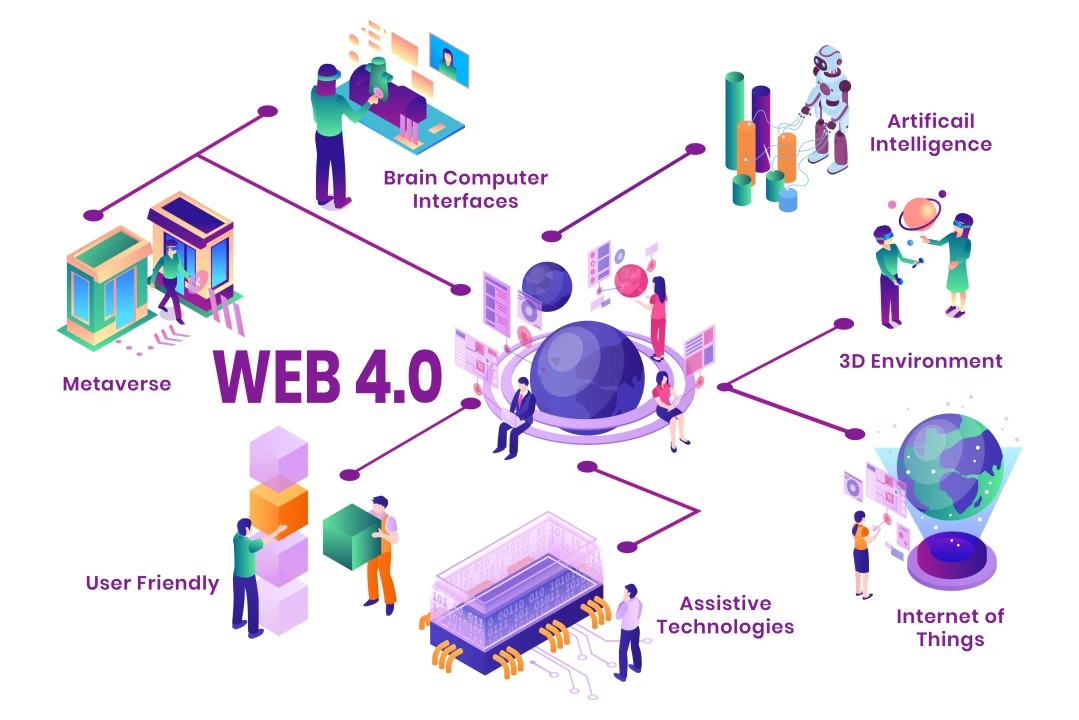
Each generation of the web represents a fundamental shift in how users interact with technology. Web 1.0 was static and informational, Web 2.0 introduced social interaction, Web 3.0 focused on decentralization and semantics, and Web 4.0 integrates intelligence directly into digital systems. This classification is documented by the World Wide Web Consortium and Wikipedia.
| Web Version | Main Characteristic | User Role |
|---|---|---|
| Web 1.0 | Static information | Reader |
| Web 2.0 | Interactive & social | Content creator |
| Web 3.0 | Decentralized & semantic | Data owner |
| Web 4.0 | AI-driven & predictive | Collaborator with machines |
2. Artificial Intelligence as the Backbone of Web 4.0
Artificial intelligence is the central enabling technology of Web 4.0. Unlike earlier recommendation algorithms, modern AI systems analyze patterns, language, behavior, and environmental data to make autonomous decisions. This shift is confirmed by research summarized by Netguru.
For everyday users, this means fewer manual inputs. Digital assistants will schedule tasks, predict needs, filter information, and optimize digital experiences automatically. These capabilities are already emerging in early forms through AI-powered assistants and smart platforms.
3. Internet of Things and Smart Environments
Web 4.0 expands beyond screens and into physical environments through the Internet of Things (IoT). Smart homes, vehicles, healthcare devices, and urban infrastructure are increasingly interconnected. According to IBM, IoT combined with AI enables real-time decision-making at the edge of networks.
For users, this translates into environments that adapt automatically—thermostats that learn preferences, vehicles that adjust routes dynamically, and health devices that monitor vital signs continuously.
4. Privacy, Identity, and User Control

Web 4.0 builds upon decentralized identity systems pioneered in Web 3.0. Blockchain-based identity frameworks allow users to control their data rather than surrender it to centralized platforms. The Blockchain Council confirms that user-controlled data is a foundational principle of the next web era.
I cannot confirm that full data sovereignty is currently achievable for all users; however, multiple pilot programs and standards are actively being developed by industry consortia.
5. What This Means for Everyday Users

Web 4.0 will make digital experiences more intuitive, predictive, and integrated into daily life. Users will spend less time navigating interfaces and more time benefiting from intelligent automation. This shift is gradual, not instantaneous, and depends on infrastructure, regulation, and public adoption.
According to World Economic Forum analysis, the biggest impact will be felt in productivity, healthcare, education, and digital accessibility.
Conclusion
Web 4.0 represents the convergence of artificial intelligence, connected devices, decentralized identity, and immersive digital environments. For everyday users, this evolution promises greater convenience, personalization, and control—while also introducing new responsibilities around privacy and digital literacy.
The intelligent web is not a distant concept; it is already taking shape. Understanding it today allows users to adapt, protect themselves, and fully benefit from the next phase of the internet.
As we embrace this intelligent web, it is essential to recognize the transformative potential of artificial intelligence across various sectors. Enhanced data analytics and machine learning capabilities will empower industries to optimize their operations and deliver more tailored services. Furthermore, the integration of AI into everyday applications will facilitate more efficient decision-making processes, ultimately improving user experiences. Staying informed and engaged with these advancements is crucial for navigating the complexities and opportunities presented by this new digital landscape.