


The AI Battlefield
Inside the Global War Between Tech Giants for AI Supremacy
We are witnessing the most consequential technological arms race in human history. In 2024, Amazon, Apple, Meta, Microsoft, and Google invested a record $170 billion in AI initiatives—a 56% increase from the previous year. But this isn’t merely about capital deployment; it’s a fundamental reorganization of global power structures, where the victors will define the architecture of human civilization for decades to come.

Act I: The Performance Competition
The AI race began as a classic talent competition, centered on a singular question: who could build the best model? When OpenAI released ChatGPT in late 2022, it seized 76.4% of the market share by early 2024, establishing itself as the undisputed leader with 800 million weekly active users and $10 billion in annual revenue. The gap between ChatGPT and its competitors appeared unbridgeable—not merely in market share, but in actual capability.
But here’s the fascinating twist: the performance gap has nearly vanished. At the start of 2024, the chasm between the strongest AI model and the tenth-ranked one stood at 11.9%. By year’s end, it had shrunk to just 5.4%. Between the top two spots, only 0.7% now separates certain performance metrics. This compression has fundamentally altered the battlefield. According to CTech analysis, “the battle was no longer between artificial minds, but between those who hold the keys to the hall, those who decide who performs, how, and for whom.”
Some companies are making token efforts, but none are doing enough. We are spending hundreds of billions of dollars to create superintelligent AI systems over which we will inevitably lose control. — Stuart Russell, OBE, Professor of Computer Science at UC Berkeley, Future of Life Institute
The Future of Life Institute’s AI Safety Index reveals a troubling paradox: while OpenAI and Google DeepMind achieved gold medal-level performance at the International Mathematical Olympiad, with their models solving complex problems that stumped human contestants, their safety practices remain deeply inconsistent. OpenAI overtook Google DeepMind in safety rankings partly by improving transparency, yet no company has a robust strategy for ensuring meaningful control over the systems they’re creating.
The Infrastructure War: Stargate and Beyond

If the first act was about model performance, the second act is about infrastructure dominance. In January 2025, President Trump announced the Stargate Project—a joint venture between OpenAI, SoftBank, Oracle, and MGX that plans to invest up to $500 billion in AI infrastructure in the United States by 2029. SoftBank and OpenAI have each committed $19 billion initially, holding 40% ownership each, while Oracle and MGX contribute $7 billion each.
By September 2025, OpenAI announced five new data center sites across Texas, New Mexico, Ohio, and the Midwest, bringing Stargate to nearly 7 gigawatts of planned capacity and over $400 billion in investment. This puts them on track to secure the full $500 billion, 10-gigawatt commitment ahead of schedule. The project has been compared to the Manhattan Project in scale and ambition—a testament to how seriously the U.S. is treating AI infrastructure as a matter of national strategic importance.
The Energy Crisis Nobody Saw Coming
Tech giants are now investing in nuclear power to fuel their AI ambitions. Google partnered with Kairos Power for small modular reactors, Microsoft reactivated a dormant nuclear reactor, and Meta is exploring nuclear alternatives. The AI revolution is driving a parallel revolution in energy infrastructure—because without power, all the GPUs in the world are just expensive paperweights.
The Combatants: A Field Guide
Microsoft’s Platform Strategy: The Moat That Matters
While OpenAI captures headlines, Microsoft is executing what may be the most sophisticated strategy in the AI wars. The company isn’t trying to build the single best AI model; instead, it’s constructing the multi-layered operating system for the AI-powered economy. This is classic platform economics played at a scale only a handful of entities in the world can contemplate.
According to Klover.ai’s strategic analysis, Microsoft’s approach rests on four pillars: Azure as the “AI operating system” for the global economy; unparalleled ecosystem integration embedding AI into the daily workflows of hundreds of millions of knowledge workers; massive capital expenditures creating formidable barriers to entry; and a strategic pivot to edge computing with Copilot+ PCs. CEO Satya Nadella frames this as the “fourth fundamental platform shift” in computing history, on par with the PC, the web, and mobile-cloud eras.
| Cloud Provider | GenAI Market Share | Traditional Cloud Share | Strategy |
|---|---|---|---|
| Microsoft Azure | 62% | 29% | OpenAI partnership, enterprise integration |
| Google Cloud | 18% | 9% | Gemini integration, research strength |
| AWS | 16% | 37% | Traditional AI leadership, developer tools |
The data reveals Microsoft’s dominance in cloud GenAI case studies—62% of 206 new projects, despite holding only 29% of overall cloud market share. This 33 percentage point overperformance suggests they’re winning the narrative battle for enterprise AI adoption, even as AWS maintains overall cloud leadership. However, Microsoft faces a critical paradox: while winning the platform war with CIOs, it’s struggling in the product war for employee hearts and minds. Even corporate clients like Amgen and Bain report employees defaulting to ChatGPT for daily tasks.
The Open Source Gambit: Meta’s Unconventional Warfare

While competitors build walled gardens, Meta is executing a brilliant flanking maneuver through open-source warfare. Its Llama model family has been downloaded over one billion times, making it the cornerstone of the open-source AI ecosystem. At LlamaCon 2025, Meta demonstrated that this isn’t altruism—it’s a deeply strategic play to become the Android of AI.
Meta’s approach creates a network effect that compounds over time. Every startup, developer, and enterprise deploying Llama-based models strengthens Meta’s frameworks, optimization tools, and developer APIs. As The Motley Fool notes, “If Llama becomes the preferred model for developers, it could emerge as the standard for AI, much like Android became the standard for smartphones.” The latest Llama 4 “Maverick” delivers inference costs as low as 10% of GPT-4o’s—a stunning leap in efficiency that could reshape economic calculations across the industry.
The Enterprise Pivot: Anthropic’s Remarkable Ascent
Perhaps the most dramatic development of early 2026 is Anthropic’s stunning revenue trajectory. The company has overtaken OpenAI in annualized revenue, hitting a $30 billion run-rate compared to OpenAI’s $24-25 billion. This is particularly remarkable given that Anthropic’s revenue was just $9 billion at the end of 2025—a more than tripling in mere months.
The secret? Ruthless enterprise focus. While OpenAI chases consumer glory with ChatGPT, Anthropic’s Claude has become the weapon of choice for serious business applications. The company now counts over 1,000 enterprise customers each spending more than $1 million annually—double the figure from just two months prior. Claude Opus 4.6 can process up to 1 million tokens of context, enabling it to ingest entire codebases, legal archives, or corporate knowledge bases without slowing down.
When 80% of your revenue comes from businesses paying for API access and enterprise contracts, your unit economics look completely different than when you’re subsidising consumers. — Kyle Redelinghuys, Technology Strategist
The Chip Wars: NVIDIA’s Dominance Under Siege
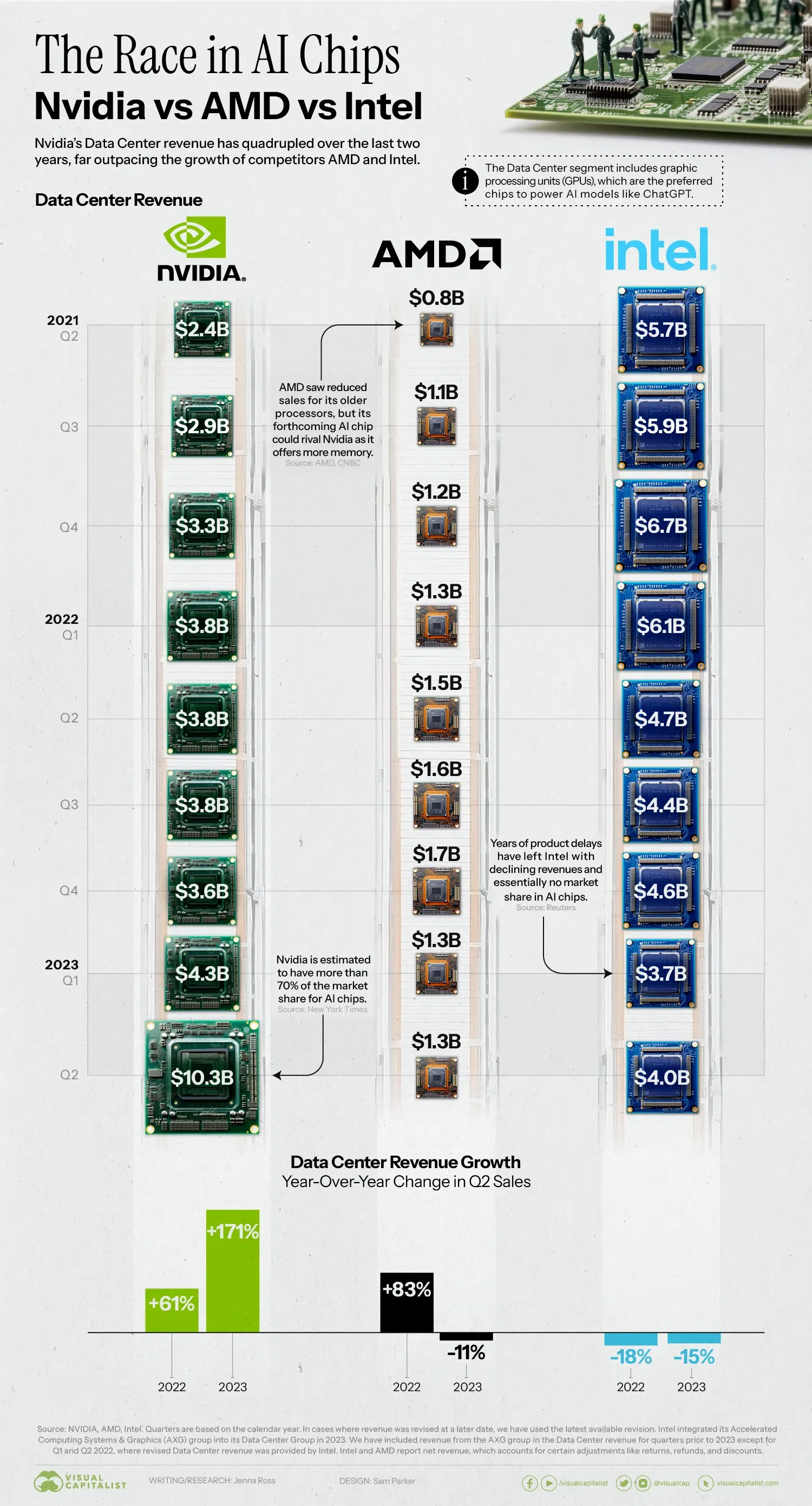
No analysis of the AI battlefield is complete without examining the silicon that powers it all. NVIDIA has become the world’s most valuable company by supplying the GPUs that train virtually every major AI model. But cracks are appearing in this empire. AMD has secured deals to supply up to 6 gigawatts of Instinct GPUs for the Stargate project, with OpenAI potentially taking a 10% stake in AMD if milestones are met. Broadcom will supply 10 gigawatts of custom hardware, signaling a shift toward specialized silicon.
Elon Musk’s xAI has taken a different approach—sheer scale. The Colossus supercomputer in Memphis now houses 555,000 GPUs with 2 gigawatts of total capacity, purchased for approximately $18 billion. This makes it the world’s largest single-site AI training installation. Musk’s strategy of on-site gas power generation and 19-day buildout timelines demonstrates a construction model that compresses what typically takes 4 years into weeks. It’s infrastructure warfare at a breathtaking pace.
The Regulatory Minefield
As the tech giants race forward, regulatory scrutiny is intensifying. Google may be forced to break into separate entities following antitrust investigations concluding it maintained an illegal monopoly in internet search. The EU’s Digital Markets Act is targeting Meta and Apple for unfair business practices. Meanwhile, the Bureau of Industry and Security has implemented tiered AI chip export restrictions, creating a complex geopolitical chessboard where technology and national security intertwine.
The regulatory landscape creates both obstacles and opportunities. Companies that navigate compliance effectively may find themselves with durable competitive moats, while those that stumble face existential threats. The AI safety debate adds another layer of complexity—anthropogenic risk concerns are driving calls for binding safety standards, yet competitive pressures push companies to prioritize speed over caution.
Act III: The Distribution Wars
As model performance converges, the battlefield has shifted decisively toward distribution and integration. The winners won’t necessarily be those with the smartest models, but those who control where we already spend our time online. This explains Apple’s strategic positioning—despite investing only $14 billion in 2026 capex compared to the $650 billion combined spend of its rivals, Apple is betting that its billion-device ecosystem and privacy-first approach will win the consumer war.
Apple’s strategy of treating foundational AI as a commodity—partnering with OpenAI and Google Gemini rather than building proprietary infrastructure—allows it to focus on user experience while avoiding the depreciating asset trap. As one analyst noted, “GPUs can lose half their value in 18 months. By treating foundational AI as a commodity, Apple focuses its resources on user experience… rather than the underlying compute power.”
The Stakes: Why This Matters
This isn’t just a corporate competition—it’s a struggle to define the substrate upon which human civilization will operate for the next century. The companies that win this war will control the infrastructure that mediates our access to knowledge, shapes our economic productivity, and potentially determines the trajectory of scientific progress itself.
The $170 billion invested in 2024 was just the opening gambit. With Stargate’s $500 billion commitment, Microsoft’s Azure expansion, xAI’s $18 billion GPU purchases, and the broader ecosystem’s capital deployment, we’re looking at potentially trillions of dollars flowing into AI infrastructure over the next decade. This scale of investment hasn’t been seen since the space race or the Manhattan Project—and the implications may be equally profound.
The Inevitability Question
Will there be one winner, or many? The evidence suggests a fragmented landscape where different companies dominate different layers: OpenAI/Microsoft in enterprise productivity, Google in consumer integration and research, Meta in open-source infrastructure, Anthropic in high-trust enterprise applications, and NVIDIA (or its successors) in silicon. The AI battlefield may resolve not into a single victor, but into a complex ecosystem of competing and cooperating powers—much like the geopolitical order itself.
What remains certain is that the AI wars are just beginning. The performance convergence we’ve witnessed is not an end state but a transition—a shift from the age of model discovery to the age of infrastructure dominance, distribution warfare, and ecosystem lock-in. The next decade will determine which of these tech giants becomes the Standard Oil, the AT&T, or the IBM of the AI era—and which become footnotes in history.
For now, the battlefield remains fluid, the alliances shifting, and the outcome uncertain. But one thing is clear: the decisions made in boardrooms from Redmond to Mountain View, from Menlo Park to San Francisco, will echo through generations. The AI battlefield isn’t just a corporate competition—it’s the defining struggle of our technological age.
